
Bear Essentials March 20th: The California Dream, Unevenly Distributed
March 20, 2026
California doesn’t completely lack opportunity — it just distributes it with extreme regional flair. This week’s stories trace a familiar pattern: jobs, housing, and even water flow more freely in some ZIP codes than others, while everyone else gets a waiting list or worse odds. From sidelined young workers to submerged tribal land, the map keeps telling the same story: prosperity here isn’t universal — it’s highly location-dependent, and always has been.
FUTURE PENDING — California’s young adults are, in technical terms, hanging on by vibes and side hustles while getting a familiar lesson in modern economics: the future is unstable, the job market is slowing, and “learn to code” has now been replaced by “hope the code doesn’t learn you.” Youth unemployment has climbed harder than the overall rate — 12.5% for ages 16 to 24, versus 5.3% for Californians ages 16 to 65 — while nearly half a million young people in 2025 were “disconnected,” out of both work and school. There is, improbably, a bright side. Today’s young Californians are still less likely to be disconnected than earlier generations, and only about 5% remain out of work and school for two straight years. But the statewide averages hide a major geographic split: young people in the Central Valley, the Inland Empire, and the northern region are far more likely to be disconnected than their peers in the Bay Area, Central Coast, San Diego, and Orange County. California’s talent pipeline is still running; it’s just delivering very different odds depending on your ZIP code.
🤫 Everything you should know
🏗️ - FROM APPLE TO AFFORDABLE — Silicon Valley’s favorite office landlord has spotted the region’s most obvious growth market: not more gleaming cubicles, but homes regular people can actually afford. The Sobrato Organization, which made billions building for Apple, Nvidia, and the rest of the silicon aristocracy, has opened The Millton in Redwood City, its first fully affordable ground-up housing project. The six-story building has more than 120 units for households earning 30% to 80% of area median income, and it sits inside a bigger mixed-use plan with market-rate housing, childcare, retail, and maybe office space later — as that market regains consciousness. CEO Tony Mestres says the goal is to prove “what’s good for the community can’t be good for business too” is a myth, while co-chief real estate officer Chase Lyman put it more bluntly: “It’s time to get dirty.” In a Bay Area where 234,000 low-income renter households lack affordable housing, that counts as both philanthropy and a dare. — SF Standard
🏘️ - CARROT AND STICK-BUILT — Congress has finally noticed America has a housing shortage, and — miracle of miracles — it responded with something other than a hearing and a shrug. KQED reports the Senate advanced the bipartisan 21st Century ROAD to Housing Act, a sprawling package aimed at making housing cheaper to build through modular construction, lighter federal reviews for some infill and rehab projects, easier federal financing, and grants for preapproved designs for ADUs, duplexes, and townhomes. Much of it reflects some of California’s most sensible housing reforms, an unusual moment when federal lawmakers seem to have copied the right homework. For California, the upside is incremental: faster factory-built housing, easier rebuilding after wildfires, and federal rules that could complement state streamlining laws and transit-oriented development. The catch is enforcement. As YIMBY Action’s Laura Foote put it, “This is all carrots.” Even supporters call it a “first step,” not the cavalry. Even if it were the cavalry, we’re still a long way from saddling up, with the bill facing headwinds in the House. — KQED
💧 - A TALL(ER) DRINK OF WATER — The feds have set aside $40 million to begin planning for a larger Shasta Dam, which is Washington’s favorite way of saying it has started an expensive fight without yet paying for the actual war. The money, tucked inside last year’s reconciliation bill, is part of nearly $1 billion for water projects across the West, with a little over $500 million headed to California. For Shasta, the goal is more storage: about 634,000 acre-feet, supposedly enough to supply 2.5 million people for a year. The catch is that this is just “planning and preconstruction activities.” Actually raising the dam would likely cost closer to $2 billion. Interior Secretary Doug Burgum presented it as a way to bolster water security, agriculture and affordability. Missing from that sunny pitch: tribal concerns, salmon, environmental opposition, and the fact that raising the dam would submerge the rest of the Winnemem Wintu’s remaining land. Progress, apparently, still comes with a flood line. - CalMatters
We rely on word of mouth to expand our Bear Essentials community. If you know others who share our desire for common sense, pragmatic solutions to California’s biggest problems, please urge them to subscribe for free! Just send them here.
🎙️ 💬 🎧 - ON THE POD: THE OTHER MOONSHOT
The Other Moonshot revisits the Apollo era through the engineers history forgot — three Black aerospace pioneers in Los Angeles whose work helped put humans on the moon while racism kept them out of the spotlight. Host Joanne Higgins pieces together a story of brilliance, exclusion, and overdue recognition, finally giving these voices airtime.— LA Made: The Other Moonshot
💻 ☮️ 🎢 - THIS WEEK IN CALIFORNIA, BUT EARLIER
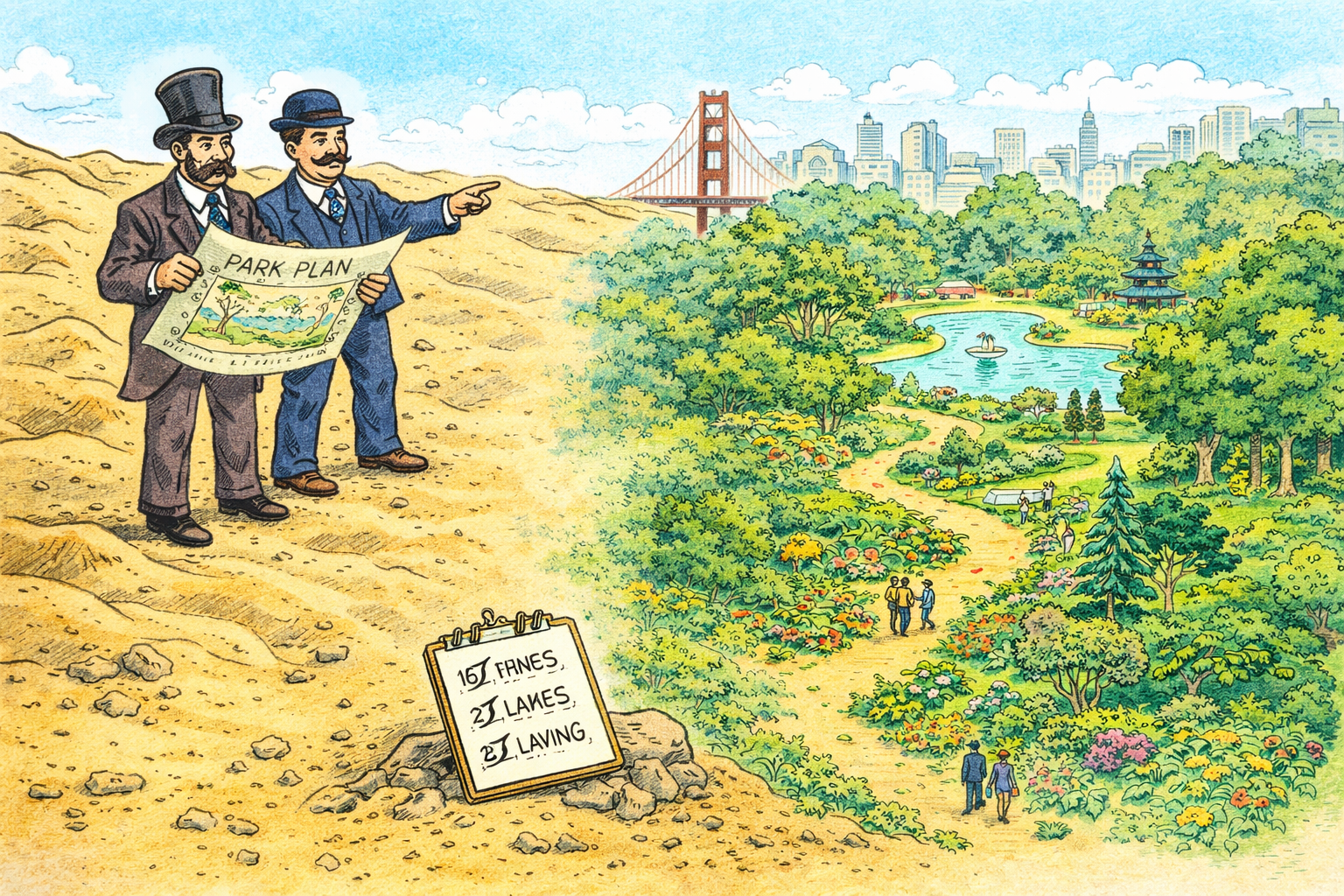
Image: ChatGPT
March 16, 1850 — Protection, Sort Of: California’s new government was barely assembled before it passed the “Indian Protection Act,” a sinister bit of irony, as the bill helped codify forced labor and strip Native Californians of basic rights.
March 17, 1870 — Sand Job: California legislators looked at more than 1,000 acres of San Francisco dunes and called it a park, which sounds deranged until you remember what Golden Gate Park looks like today. Sometimes the state’s biggest flex is simply forcing nature to take notes.
March 17, 1969 — Hemlines of Dissent: Levi’s put bell-bottoms on shelves and helped turn Bay Area counterculture into a national dress code. Anti-establishment style went mass market, proving rebellion looks even better once it’s properly branded.
March 20, 1999 — Block Party: Legoland opened in Carlsbad, giving Southern California one more impeccably engineered attraction for children and the adults doomed to accompany them. The first Legoland outside Europe landed exactly where theme parks already functioned as regional infrastructure.
March 22, 1993 — Pentium State: Intel shipped the first Pentium chip and Silicon Valley added another brick to its growing myth of world domination. Faster computing arrived, and California once again found itself selling the future before everyone else had finished booting up.
🏃♂️ 💨 ✋ FAST FIVE
- 🆘 $190M for new mental health, addiction treatment centers coming to Bay Area. East Bay Times
- 👨⚖️ California sues EPA over repeal of greenhouse gas rule. Sac Bee
- ✂️ Trump administration acknowledges it needs immigrant farmworkers as it moves to cut their pay. CalMatters
- 🤝 California pledges to open 7% of its land and waters to Indigenous tribes. LA Times
- 🧑💻 S.F. launches portal to bring property paperwork into the digital age. SF Chronicle
