
Bear Essentials February 20th: The Future is a Multiverse
February 20, 2026
The future rarely shows up as a single headline — it leaks in through the seams of ordinary life. In California, that means safer streets on paper while theft becomes the ambient soundtrack of daily commerce. It means LA is learning that pouring concrete doesn’t defeat physics, so the real upgrade is making distance smaller. It means a Sierra Nevada that can’t be counted on to store water in frozen form, policy shocks that force small businesses to operate like they’re in a storm zone, and a flurry of energy moves in the hope of a more affordable tomorrow.
CRIME AFTER CRIME — California’s crime numbers are a reality check for the “everything’s on fire” crowd — and the “nothing to see here” brigade. The headline from PPIC’s latest report tells the story: “California’s violent crime rate decreased in 2024 but remains above pre-pandemic levels.” Violent crime fell 5.3%, from 508 to 481 incidents per 100,000, yet sits 9.8% above 2019. Homicides dropped 13.5%, robberies 7.5%, and assaults eased 4.8%, but aggravated assaults remain 22% higher than pre-pandemic, and gun-involved assaults are still 33.6% above 2019 even as the firearm share dipped to 18.4%. Property crime did the retreat: down 9.9% to 2,084 per 100,000, the lowest since 1985. Shoplifting spiked 14.2% (48% above 2019) and auto theft, though down 16.7%, stays elevated. Regionally, the San Joaquin Valley leads violent crime (603 per 100,000) while the Bay Area tops property crime (2,678). If this trajectory holds, the future is less “crime wave” than chronic, high-volume theft that keeps politics — and store shelves — on edge.
🤫 Everything you should know
🚄 - BORE TO BE WILD — LA spent $1.1 billion widening the 405 and got the most LA result imaginable: more traffic. So, Metro is pivoting from “just add lanes” to “stop pretending the canyon is flat,” with the Sepulveda Transit Corridor, an all-underground, automated heavy-rail line under the Santa Monica Mountains. The pitch is brutally simple: 13 miles in under 20 minutes by train, versus 40–80 minutes by car (plus the attendant brain damage), with trains every 2½ minutes and platform screen doors to protect waiting riders. It’s not just a commute tweak; it’s a geometry correction for a city where jobs and housing live on opposite sides of a mountain. Transit activist Michael Schneider describes the project with elegant simplicity: “You shrink the city.” Yes, it’s eye-wateringly expensive and funding is still a puzzle, but the route is set, the reviews are moving, and LA’s wider rail buildout is already making “train is faster than driving” a real sentence people say out loud. — Bloomberg
❄️- NO FLAKE ZONE — California’s “Snowy Range” is might need to start prepping for a rebrand. A Berkeley Lab co-led review in Nature Reviews Earth & Environment says the Sierra Nevada and other Western ranges could go nearly snowless for years at a time. The projections are downright scary: five-year snow droughts by the 2040s, 10-year stretches by the late 2050s. That wouldn’t be so bad, except California’s snowpack supplies about 30% of the state’s freshwater. The West’s snowpack is already down ~20% since the 1950s — about a Lake Mead’s worth. “We don’t have any historical analogues… [it’s] a totally different beast,” says Berkeley Lab’s Erica Siirila-Woodburn. It’s concerning, but the answer is clear. We have urgent work to do to build out water infrastructure at scale, ramping up recycling efforts, banking the wet stuff underground, building new reservoirs and improving the efficiency of our delivery systems. — California Magazine
🧊 - THE PRICE OF ICE — Los Angeles County says last summer’s immigration enforcement didn’t just rattle nerves—it emptied cash registers. A County report (311 businesses surveyed) puts the damage at $3.7 million in losses from July–September, with 82% reporting negative effects and 44% saying they lost more than half their revenue. The pain point wasn’t subtle: 70% reported staffing shortages, and 33% said workers were scared to show up at all. County leaders framed it as policy whiplash: “our businesses recorded millions of dollars in losses in a matter of months,” Supervisor Janice Hahn said. Republicans, meanwhile, dismissed the whole thing as a pretext, arguing the Board “wants to justify further tax increases on the law-abiding citizens of Los Angeles.” Politics aside, the impacts are real. If this becomes the new normal, LA’s small-business economy won’t just “feel impacts” — it’ll start baking enforcement crackdowns into its operating model: fewer hours, fewer hires, thinner margins, and more “For Lease” signs where neighborhood staples used to be. — Pasadena Now
We rely on word of mouth to expand our Bear Essentials community. If you know others who share our desire for common sense, pragmatic solutions to California’s biggest problems, please urge them to subscribe for free! Just send them here.
🎙️ 💬 🎧 - ON THE POD: RURAL SUICIDE
CapRadio health reporter Sammy Caiola spent six months examining why suicide rates run so high in rural Amador County and nearby Northern California communities. Through personal accounts and interviews with prevention workers, she explores how depression, anxiety, addiction, and isolation can deepen in rural life — and what practical, local solutions might help. — Cap Radio
👴🏽 📜 ⌛ - THIS WEEK IN CALIFORNIA HISTORY
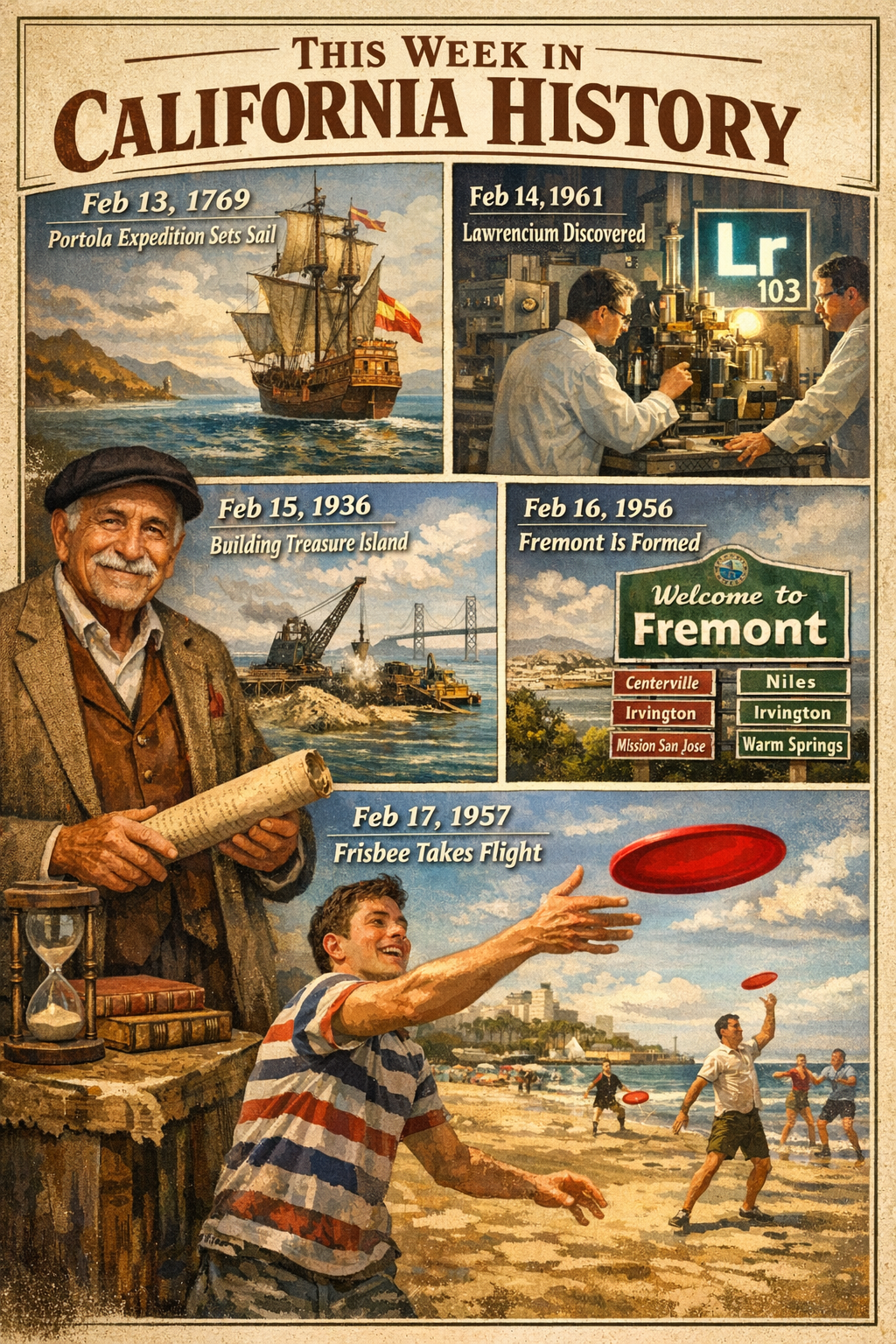
Feb 13, 1769 — La Paz? More Like “Let’s Go”: The San Antonio sails out of La Paz under Juan Pérez, on a Portolà-backed mission to plant the Spanish flag in Alta California. The boat ride became the opening act for San Diego and Monterey — California’s origin story, written in salt air, ambition, and imperial paperwork.
Feb 14, 1961 — Roses Are Red, Element 103: UC Berkeley’s Lawrence Radiation Lab synthesizes Lawrencium, a radioactive, made-in-a-lab newcomer to the periodic table named for Ernest O. Lawrence. Cupid brought chocolate; Berkeley brought a brand-new element. Both are hazardous in large doses.
Feb 15, 1936 — Build-A-Bay Workshop: The Army Corps starts dredging and pumping fill into San Francisco Bay to create Treasure Island — because when you need land for a world’s fair, you simply manufacture it. It later becomes a naval station, proving the best way to “find” treasure is with a budget and heavy machinery.
Feb 16, 1956 — Fremont: Five Into One: Centerville, Niles, Irvington, Mission San Jose, and Warm Springs merge into Fremont, named for explorer-statesman John C. Frémont. A civic Voltron forms in the East Bay—different neighborhoods, one city seal, and a shared future of being asked, forever, “Wait… where exactly is Fremont?”
Feb 17, 1957 — Let It Rip: Walter Morrison sells the rights to his beach-hustled “Flyin’ Cake Pans” to Wham-O in Woodland Hills. A year later it becomes the Frisbee, launching America’s favorite pastime: casually hurling plastic at friends and calling it “outdoor recreation.”
🏃♂️ 💨 ✋ FAST FIVE
- 🔌 Newsom appoints a new utilities regulator with a mandate to cut costs. CalMatters
- 🔪 SF zoning plan under attack from both sides of S.F.’s housing wars. SF Chronicle
- 👩⚖️ CA sues Trump for illegally axing $1.2B in energy and infrastructure programs CA Gov
- ⚡ Trump lashes out at Newsom’s green energy deal with UK. The Guardian
- 👀 EPA’s retreat may embolden California climate policy. POLITICO
